Hidden Objects Quest: Find it
- 4.7
- Rating
- 100.00K
- Installs
- Free
- Price

 Analysis by App-foxy
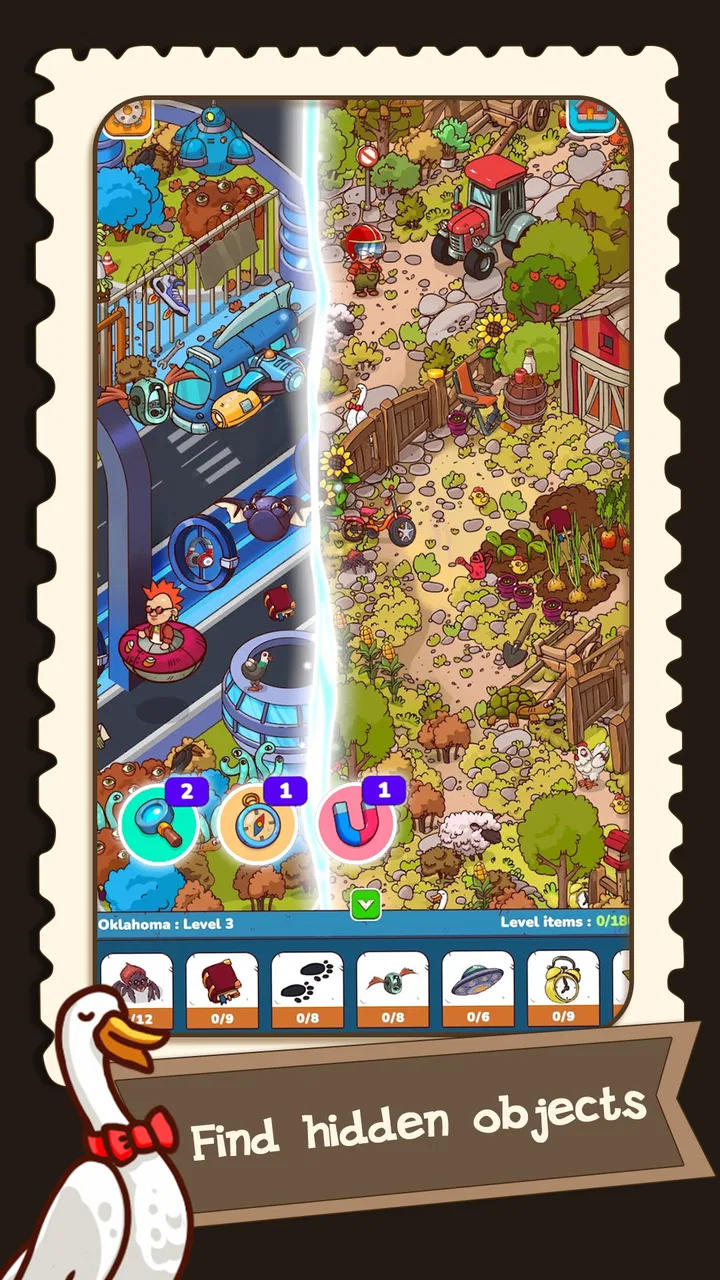
I went into Hidden Objects Quest: Find it expecting a simple way to pass a few quiet minutes, and that is exactly where this arcade game makes the strongest impression. Its central idea is easy to understand: inspect a busy scene, locate the requested objects, and keep your attention steady until the picture gives up its secrets. GameOn Production KZ keeps the focus on observation rather than complicated controls, so I could start playing without learning a long rule set or managing a character.
My overall view is positive, with one important qualification. This is best treated as a relaxed visual-search game, not as a deep adventure or a competitive arcade challenge. The pleasure comes from noticing small details and improving the way I scan an image. If you enjoy hidden-object puzzles, it offers a convenient, approachable version of that pastime. If you need constant action, a strong story, or a large strategic system, its deliberately narrow design may feel too modest.
What the search gameplay feels like in practice
The first thing I noticed was how quickly the game communicates its purpose. A scene appears, the target list gives me a reason to look closely, and the challenge becomes a conversation between my eyes and the picture. I am not trying to memorize a complicated map or master timing-based movement. I am comparing shapes, colors, outlines, and context, often moving from the broad composition toward the tiny corners where an object can blend into the surroundings.
You May Also Like

 Blood Strike: 2.5 Anniversary
Blood Strike’s Loadouts Turn Every Drop Into a Tactical Gamble
A close look at Blood Strike’s custom loadouts: how fast access to signature weapons reshapes its battle royale rhythm, rewards preparation, and narrows the gap between fights.

 Pandora - Music & Podcasts
Pandora’s Music Is Easy to Start, but Harder to Recover
Pandora’s strength is its low-effort path from a seed to a station. Its weak spot is how much confidence it asks you to place in connection, setup, and quiet recovery.

 8 Ball Pool
 Is Built on Rivalries, Rematches, and Routine
A close look at the rivalries, rematches, shared routines, and unanswered safety questions that turn a quick pool match into a persistent mobile community.

 Samsung Music
’s Quiet Strength Is Playing What You Already Own
Its reach comes less from spectacle than from dependable access to a personal library. That simplicity is both the app’s strongest retention engine and its ceiling.

 AccuWeather: Weather Radar
AccuWeather Review: A Quick, Clear Forecast for Everyday Decisions
For everyday plans, the best forecast is the one you can understand quickly. AccuWeather makes rain timing, radar, and local conditions easy to act on, with a few trade-offs.

 Hill Climb Racing
Why Hill Climb Racing Still Turns Crashes Into One More Run
A tiny car, a bumpy hill and one more upgrade: Hill Climb Racing keeps resurfacing because its simple chaos makes every near-miss feel personal.
More From Our News Desk
View All News


That simplicity is not the same as being effortless. A well-hidden item can make me slow down and change my method. Instead of sweeping randomly across the screen, I found it more useful to divide the image into sections: upper edge, center, lower edge, and then the sides. I also tried looking for unusual color patches first, followed by objects whose silhouette did not match their surroundings. This kind of routine turns the game into a small concentration exercise rather than a pure guessing session.
The arcade classification makes sense because the interaction is immediate and repeatable. I can pick it up when I have a short break, play without preparing for a long session, and stop after completing a search. That makes it suitable for a commute, a waiting room, or a quiet moment after work. In my experience, the most satisfying sessions were not necessarily the longest ones; they were the moments when I found a difficult item just before giving up.
The game’s free entry also lowers the risk for curious players. It is available at no upfront cost, and the age rating is Everyone, which makes the basic concept approachable for a broad audience. The presence of optional in-app purchases, ranging from ninety-nine cents to forty-eight dollars and ninety-nine cents per item, is worth keeping in mind before spending time with it. I would personally begin with the free experience and only consider a purchase if I already knew that the search format suited me.
Why the visual hunt works better than it first appears
The strongest part of this game is the way it rewards a repeatable visual habit. When I first enter a scene, my attention tends to jump toward obvious objects. After a few searches, I become more deliberate: I check repeated patterns, inspect areas where an object could be partially covered by the background, and compare the target’s likely shape rather than searching only for an exact color. That change in approach gives the game a small but real learning curve.
There is also a useful difference between recognizing an object and locating it. I may know exactly what I am looking for, yet still miss it because the scene uses scale, placement, or surrounding detail to disguise it. That gap creates the game’s main tension. It is gentle tension rather than pressure-heavy excitement, but it is enough to keep me engaged when the picture is thoughtfully arranged.
For players who like casual puzzles, this can be more rewarding than an endless stream of interchangeable tapping games. The action is still simple, but success depends on attention. I found myself looking more carefully at the whole image instead of tapping every suspicious area. That matters because blind tapping removes the point of a hidden-object challenge: the fun comes from the moment of visual recognition.
A practical tip helped me avoid frustration. When I could not find an item, I stopped staring at the same central area and deliberately changed the scale of my attention. First I looked at the scene as a collection of large zones, then I examined edges and clusters of similar details. If that failed, I searched by object category, asking where that kind of item would naturally appear in the scene. This method is more effective than repeatedly scanning the entire picture with no plan.
The useful role of short sessions
I would not describe the game as something that demands a dedicated evening. Its appeal is strongest when I want a contained activity. For example, if I have ten quiet minutes before an appointment, I can open it and focus on a visual task instead of starting a larger game that needs a long commitment. The search format also works well when I want something calmer than action games but more active than watching a video.
That makes it a reasonable choice for families as well, although the experience will depend on the player’s patience and eyesight. Younger players may enjoy the discovery element, while adults may appreciate the concentration involved. I would supervise purchases on a shared device, not because the game’s premise is complicated, but because optional item pricing can become significant at the upper end if someone taps through without thinking.
It can also serve as a small reset between demanding tasks. I found that a focused search gives my attention one clear job, which feels different from scrolling through social feeds. I would not present it as a formal training tool, but it does encourage careful visual inspection and persistence. The benefit comes from playing attentively; rushing through every scene or relying on random taps removes much of what makes the format worthwhile.
Where the experience has limits
The same narrow focus that makes the game accessible can also limit its staying power. There is no need to manage a character, build a team, solve a multi-stage mystery, or make meaningful strategic choices. If you usually play arcade titles for speed, reflexes, or escalating difficulty, a hidden-object search may feel static. The game asks me to look, identify, and tap; players wanting more varied interaction should choose a different kind of casual game.
Repetition is another consideration. Even when the scenes are enjoyable, the core action remains the same. I can improve my scanning technique, but I am still performing a visual hunt each time. That is ideal for people who like a familiar rhythm, yet less appealing to anyone who needs frequent changes in mechanics. I would recommend trying it during a free session before deciding whether it has enough variety for regular long-term play.
Hints and purchase decisions can also affect the balance of a search game. When I am stuck, the temptation is to look for the quickest assistance rather than keep examining the scene. Because the available purchase range reaches from a small amount to a much larger one, I would set a personal spending limit before using any optional help. The free price is a good reason to test the game, but it should not be confused with an unlimited commitment-free experience once purchases enter the picture.
Another weakness is that visual-search games can become tiring in the wrong conditions. A small screen, glare, poor lighting, or a rushed environment makes subtle objects harder to distinguish for reasons unrelated to puzzle quality. I got better results by increasing attention to the whole scene and taking a short break when my eyes began to skim. This is not a flaw unique to the title, but it matters when deciding whether it fits your daily routine.
Compared with a traditional puzzle game, this one offers less variety in how I solve a problem. A word puzzle may let me reason through clues, while a match-style arcade game may reward quick pattern recognition and chain reactions. Compared with a story-driven hidden-object adventure, this is the more direct option: I can concentrate on finding things without needing to follow a narrative. That is a strength for short sessions, but a weakness if atmosphere and plot are the main reasons I play.
Who should install it, and who should pass
I would point this game toward players who enjoy quiet observation, casual puzzle routines, and the satisfaction of spotting something that was visible all along. It is especially suitable for someone who wants an easy-to-start activity with no complex control scheme. The Everyone rating supports its broad accessibility, while the arcade format keeps the barrier to entry low.
I would also recommend it to people who like setting small personal challenges. Instead of simply completing a scene, I can try to reduce random tapping, improve my scanning order, or finish a search without immediately reaching for assistance. Those self-imposed goals add depth without pretending that the game is a full strategy experience. They are a good way to keep the familiar format interesting.
On the other hand, I would skip it if my priority is fast reflex action, competitive ranking, elaborate progression, or a strong narrative. The store summary presents a treasure-finding premise, but the actual appeal is the search itself, not a large adventure system that surrounds it. Players who need constant novelty may enjoy it briefly and then move on. That is not a criticism of its intended style; it is simply the clearest boundary of the experience.
Device compatibility is also straightforward for many older phones and tablets, since the minimum operating system is Android 6.0. The current version is 1.06.03, which is the build I would look for when checking whether my device is ready. I would still make sure the game runs comfortably on the particular screen I plan to use, because the quality of a hidden-object session depends heavily on being able to inspect small details without strain.
The game has built a strong audience for a relatively focused title: it has passed one hundred thousand installs and holds a 4.8 average from around two thousand four hundred ratings. Those figures suggest that its straightforward approach connects with many players. I would treat that as encouraging rather than decisive, because enjoyment here depends strongly on whether visual searching is already the kind of activity I find relaxing.
My final recommendation
After spending time with it, I see Hidden Objects Quest: Find it as a focused, friendly arcade game that understands its own appeal. It does not need complicated systems to create a satisfying moment. The best searches reward patience, organized scanning, and the little burst of recognition that comes when a concealed object finally becomes obvious. GameOn Production KZ has chosen a format that is easy to enter and comfortable to revisit in short sessions.
My recommendation is to try the free version if you enjoy hidden-object puzzles or want a calmer alternative to reflex-heavy arcade games. Start with a deliberate scanning method, avoid random tapping, and decide in advance how you feel about optional purchases. Those small choices make the experience more enjoyable and help prevent the main frustration from becoming unnecessary spending.
In the end, this is not the right game for everyone, and it does not try to be. Its weakness is the same as its strength: the search remains the center of almost everything. For me, that makes it a good companion for brief breaks and relaxed concentration, but not a replacement for a deeper adventure or a more varied arcade title. If you want a simple visual challenge that rewards careful looking, this is an easy game to recommend.
FAQs for Hidden Objects Quest: Find it
01What is Hidden Objects Quest: Find it?
Hidden Objects Quest: Find it is a puzzle game that challenges players to locate specific items hidden within intricate and detailed scenes. The game offers various levels with increasing difficulty, providing an engaging experience for players who enjoy testing their observation skills and attention to detail.
02Is Hidden Objects Quest: Find it free to play?
Yes, Hidden Objects Quest: Find it is free to download and play on both Android and iOS platforms. However, it may include in-app purchases for additional features, hints, or to unlock certain levels. These purchases are optional, allowing players to enjoy the game without spending money.
03What are the main features of Hidden Objects Quest: Find it?
The game features a wide range of beautifully designed scenes, each with unique themes and challenges. Players can enjoy multiple levels with varying difficulty, daily challenges, and timed events. The game also offers hints to assist players when they are stuck, enhancing the overall gaming experience.
04Are there any age restrictions for Hidden Objects Quest: Find it?
Hidden Objects Quest: Find it is suitable for players of all ages. Its user-friendly interface and simple mechanics make it accessible to younger players, while the challenging levels provide enough complexity to engage older audiences. Parents can feel confident that the game is appropriate for children.
05Can I play Hidden Objects Quest: Find it offline?
Yes, players can enjoy Hidden Objects Quest: Find it in offline mode. This makes it a perfect choice for playing during travel or in areas with limited internet connectivity. However, some features like daily challenges and updates may require an internet connection to access.
Pros
- Engaging and immersive gameplay.
- Wide variety of scenes to explore.
- Challenging puzzles enhance replay value.
- Stunning graphics and sound design.
- User-friendly interface and controls.
Cons
- Can be repetitive over time.
- In-app purchases can be costly.
- Requires constant internet connection.
- Occasional ads disrupt gameplay.
- Limited hints can frustrate players.

Hidden Objects Quest: Find it
Gallery